Welcome to the Onshape forum! Ask questions and join in the discussions about everything Onshape.
First time visiting? Here are some places to start:- Looking for a certain topic? Check out the categories filter or use Search (upper right).
- Need support? Ask a question to our Community Support category.
- Please submit support tickets for bugs but you can request improvements in the Product Feedback category.
- Be respectful, on topic and if you see a problem, Flag it.
If you would like to contact our Community Manager personally, feel free to send a private message or an email.
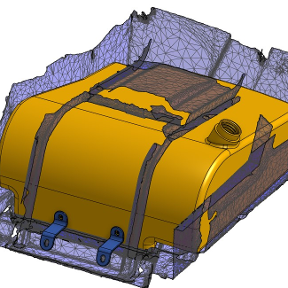
help turning imported STL surface mesh into solid part

Hi everyone,
I have a bit of a problem.
I built a boat using a ship design programme for a project at university.
Now I want to continue using it and convert the hull into a boat to use as an RC boat.
Is there a way to get such a STL mesh into a part?
I'm a bit out of my depth with my skills so if anyone can help that would be really great.
Thanks in advance
https://cad.onshape.com/documents/b6092195daadda0dcd1167ed/w/016b22b28e15751e7039e920/e/55c963aa6e25a04ce2da48ba
Best Answers
-
Can open the linked part studio, For anyone in this group to view and make comments it needs to be made public.
0 -
With the latest update that came out yesterday, you now have a new tool to create surfaces constrained by points. I believe this might be of great value when building clean surfaces on your imported STL model.
I just gave it a try, mostly out of curiosity for the new tool. I derived your hull model into a new document to enable the new constrained surface tool, for existing documents aren't yet updated.

It actually works, surprsingly well, also on your file, but to be brutally honest: Your STL model is of such evil quality that I wouldn't build a single thing upon it, but rather rebuild it from proper sections and guides. Because I'm curious: What was the name of that ship design application you used to create the hull and what was the objective which lead to this strange potato shaped hull?
1 -
I couldn't get the original surface to mesh and had to split it. Bit tricky to thicken as well. Had to add a fillet to beak sharp edge along keel. The new constrained surface 🤗 sure helped. I have to agree with Martin on the quality of original STL surface.
 2
2


Answers
-
Can open the linked part studio, For anyone in this group to view and make comments it needs to be made public.
0 -
depends on the mesh. you'll have to figure how to make your document available for others to see.
0 -
Okay now it is publick. https://cad.onshape.com/documents/b6092195daadda0dcd1167ed/w/016b22b28e15751e7039e920/e/55c963aa6e25a04ce2da48ba?renderMode=0&uiState=67d3ebfdf44ca37f3c2b0b4d
0 -
Okay the document is now public, have togth wit the link is is automnatilcy publick
0 -
With the latest update that came out yesterday, you now have a new tool to create surfaces constrained by points. I believe this might be of great value when building clean surfaces on your imported STL model.
I just gave it a try, mostly out of curiosity for the new tool. I derived your hull model into a new document to enable the new constrained surface tool, for existing documents aren't yet updated.
It actually works, surprsingly well, also on your file, but to be brutally honest: Your STL model is of such evil quality that I wouldn't build a single thing upon it, but rather rebuild it from proper sections and guides. Because I'm curious: What was the name of that ship design application you used to create the hull and what was the objective which lead to this strange potato shaped hull?
1 -
I couldn't get the original surface to mesh and had to split it. Bit tricky to thicken as well. Had to add a fillet to beak sharp edge along keel. The new constrained surface 🤗 sure helped. I have to agree with Martin on the quality of original STL surface.
2 -
Thanks for the help, I have started to try and do it myself and failed.
Normally I use Delftship and Bentley to calculate the ships, it is mainly a calculation program for normal sized ships. So the triangles are not optimal for small curves. So not optimal for this ship, but I am comfortable with it.
The shape is not optimised for stability in waves, so it does not move that much. In the real world, the Ulstein X bows are the inspiration. They look fancy and have a lot of advantages in theory, if that is the case I want to test this model after 3D printing in the towing channel at the university.1