Welcome to the Onshape forum! Ask questions and join in the discussions about everything Onshape.
First time visiting? Here are some places to start:- Looking for a certain topic? Check out the categories filter or use Search (upper right).
- Need support? Ask a question to our Community Support category.
- Please submit support tickets for bugs but you can request improvements in the Product Feedback category.
- Be respectful, on topic and if you see a problem, Flag it.
If you would like to contact our Community Manager personally, feel free to send a private message or an email.
Best Of
Default BOM column widths
Is there a way to default the column width of BOM tables in the assembly? I have a BOM that is used to check that relevant metadata has been filled out prior to releasing an assembly but this is only viewed in the assembly and not used on drawings. I've found that the columns default to the same width when I create a new assembly whereas I'd like certain columns to be smaller (Item, Quantity, etc.).
I've tried creating the BOM template through the dots and 'save as template' and using it another assembly but found the columns still defaults to equal widths.
Current default:
Desired default widths:
Cheers, Hannah
Senior Mechanical Design Engineer with 18 patents, ex Dyson NPI looking for Onshape work.
I am an experienced CAD designer with over twelve years of experience in mechanical design and creative design, a BSc (Hons) in Automotive Design Technology and proficiency in Onshape.with extensive background experience using Creo, Nx, Solidworks, PDM such as Windchill and Teamcentre and also cross industry experience using polygon based programs such as Cinema 4d and Unreal, I also have FEA experience in onshape using the extension simscale.
As Senior engineer at Dyson I have developed detailed CAD models and managed BOMs for complex electro-mechanical systems, including the latest product, the Dyson pencil vac for which I conceptualised and led the cleanerhead project. At Dyson, I used NX to create and prototype innovative products, and hand built prototypes for testing an verification before they went on to productionisation. During my time at Dyson I secured seventeen patents. My hands-on experience with CNC machining, injection moulding, and product testing ensured robust designs and efficient production. I also have significant experience in translating customer requirements into functional concepts, as demonstrated at Kohler, where I led projects from ideation to production gained my first patent, and visited China to verify my projects before release.
Based near Totnes, Devon, I am looking for a remote role, I am experienced with WFH as have been running my own business. I am confident my technical expertise and creative problem-solving skills will add value to your projects. Please contact me know at andywarner@me .com to discuss how I can contribute.
Thanks!
Andy andywarner@me.com
Re: How Do I Make A Wolf In Onshape
Hmm, depends. Does it have to be a live wolf? How are you manufacturing it?
_anton
Re: Onshape AI Advisor Beta (Coming Soon)
I just tried another fairly straightforward question which AI Advisor couldn't help with. I even tried modifying my question to mirror what's deep in the help.
The correct answer would be here:
https://cad.onshape.com/help/Content/drawings-dimensions.htm
S1mon
Re: Automatic Assembly Sequence Generation
.
Legit! Very impressive.
Ty for the offer! Personally I don't have need of this atm, I just develop and test things related to Onshape.
.
Re: Automatic Assembly Sequence Generation
This is really interesting. I'll be testing it out in coming weeks
Re: Branch Clutter!
This sounds like a combination of things: Onshape could add some more guard rail functionality, AND a best practice needs to be developed and made explicit at your company. I personally don't see value in the twigs thing, and it could add an exponential level of complexity to the version graph.
Functionality I'm interested in:
- granular permissions for branches - There's value in thinking of each branch as "owned" by a certain person, and it could be valuable to give the ability to prevent everyone but the owner of a branch for editing it. There could be a single "Branch Settings" dialogue for branch permissions which lets you specify users, and certain action limitations (like releasing).
- selecting which branches are visible to import or search - As you say, it can become cluttered when you have 6 copies of the same part in 6 branches. It would be great to have a way to mark some branches as important, and others as not. It could be as easy as the "critical" branch items always sort to the top, but they're all still there. Even this could be part of the Branch Settings menu.
- An easy way to tell who made which branch - As with all collaborative environments, it's easier to add things than clean them up because it's risky to remove clutter that you didn't make and may not understand. It's the same reason shop spaces are usually a mess. Things flow into them freely, but no one knows what's garbage. If there were an easy way for people to know who made a branch they can ask them if it can be deleted now.
But there will always be a branch hygiene element to it, which is a sociological problem, not a software problem. It's about setting and keeping SoPs for how branches are and aren't used. An easy one could be to ask people to append their name to the branch name so it's obvious who to ask about it. Another could be getting clear on the CAD strategy before beginning a project. Before any work is done the whole project team should understand how data flows through the design, and at what milestone the project should split into multiple documents. (Often a good practice is to start in 1 doc while things are changing a lot, then split out once the design is beginning to gel). No amount of Onshape functionality can replace the team's mutual understanding of the CAD plan and SoPs. It's a compound challenge involving people, process, and tools, and the solution needs to address all 3. I help with this stuff at www.theonsherpa.com.
Re: Problems with loft and thickening
A few notes:
- There's a visual crease or kink in your surface, which is usually a bad thing. Consider modeling this in more than one surface patch. See the Intro To Surfacing lesson in the learning center
- You should aim to use fewer cross sections. You want to get to the end result with as little constraint on the surface as possible.
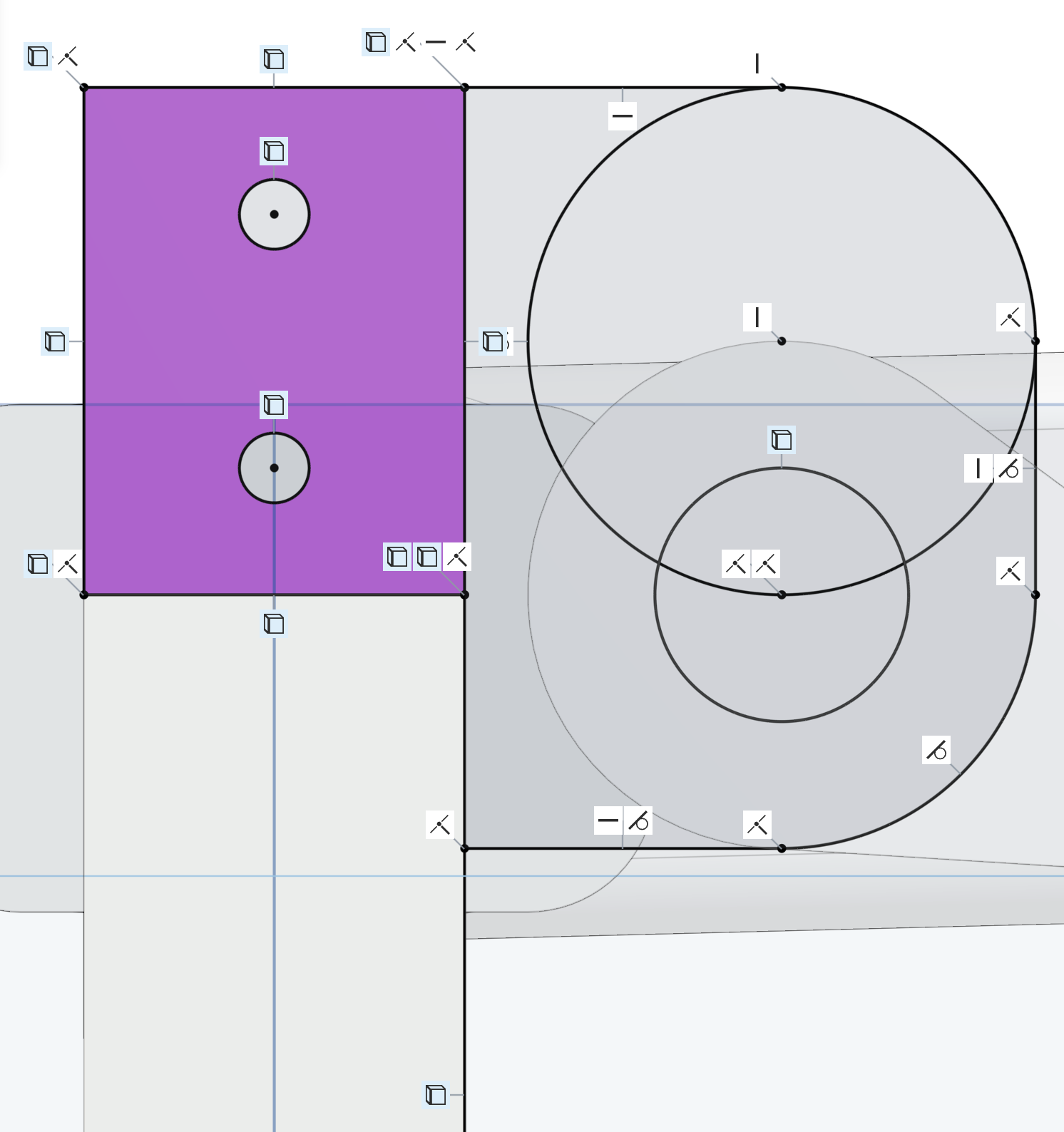
- When you thicken (or offset, or shell) it will fail if the offset surface begins to intersect itself. It's easier to visualize in 2D like this. Notice how it fails once the offset comes to a point.
You can evaluate the curvature of your surface with the Curvature Color Map tool. You can set it to minimum radius, and play with the color sliders to find the area of least curvature. When you mouse over the surface it shows the radius of curvature at that point. The smallest number here is the number at which your thicken will fail.