Welcome to the Onshape forum! Ask questions and join in the discussions about everything Onshape.
First time visiting? Here are some places to start:- Looking for a certain topic? Check out the categories filter or use Search (upper right).
- Need support? Ask a question to our Community Support category.
- Please submit support tickets for bugs but you can request improvements in the Product Feedback category.
- Be respectful, on topic and if you see a problem, Flag it.
If you would like to contact our Community Manager personally, feel free to send a private message or an email.
Best Of
Re: Can robust complex surfaces be modelled.
@euan_dykes I do think it can be taught, but I do think some people are better at starting things and some are better at finishing them, and that's okay. Roll with it.
I also hold onto a concept I helped establish at my last company of "levels of CAD" I had a video about it at one point that's been taken down and I plan to re-create it, but the gist is this: The level of rigor in your CAD should be proportional to the clarity of design vision. Rigor means a model that's robust to change, navigable by guests, and lightweight to compute.
To break that down imagine a design starts as a sketch on a napkin. There's the spirit of an idea and not much else. There's not confidence it is desirable (people want it), feasible (it can be done), and viable (makes business sense). At this early stage it makes no sense to make incredibly robust "good" CAD. Your CAD should suck, but be quick to do (Level 1). This CAD is just for the CADder, and no one should care how messy it is anymore than they'd care what messy napkin sketches they have stuffed in a drawer. Iterate until you and your team agree it's believable that it could tick the three boxes of desirability, feasibility, and viability (DFV). You don't have total proof, but it seems worth investing time in proving. Here you begin iterating over the same concept, but with little variations. The core idea is pretty locked in, but there's work needed to actually prove DFV. You're probably trashing all of the models you've made so far, and beginning from near scratch on this Level 2 model. This is when your team might begin sharing models and making prototypes you want to keep track of, so you need just enough rigor to support that. Things should be named, feature folders used, old irrelevant tabs deleted, etc. Once you've iterated enough that you have confidence in DFV and a clear design vision (a very concrete idea what you want to make), then the business is ready to commit to the real product development. That's when it's time to do Level 3 CAD, which is the very robust kind of CAD you were asking about here.
You mentioned risk reduction, and that's exactly right, but the risk at the beginning of the project is over-investing in an idea that isn't going to work, and the risk at the end, is that you do a bad job making it. The beginning is about making the right thing and the end is about making the thing right.
Without everyone agreeing where the project should be sitting on the speed-rigor continuum, you won't agree on what kind of CAD is appropriate. Your ID friend might actually be right that it doesn't make sense to make a really stable model because the entire design vision is also not stabilized. But if the company is committed to the product and it's production CAD I think it is worth the time making it very robust. I find that people (let alone teams) are not clear with themselves about this continuum, and therefore overdo it on Level 1 CAD and under do it on Level 3 CAD, when really their worst CAD should be even "worse" and their best CAD should be better.
Wow that got longer than I meant. I'm getting excited to re-capture it in video form!

Re: Not a Feature: Luminary Cloud Import Checkpoint
Thank you for your help. We'll try to address it asap
 lana
lana
Re: Anyone have an FS that can convert a decimal length to a (reduced) fractional equivalent
Looks like this was already solved a few times over, but here is a similar feature for this incase future users need something.
Decimal to Fraction
https://cad.onshape.com/documents/0ac50e48c2cd6af90faa62a8/w/256a5d01d7e4265ac46fed…
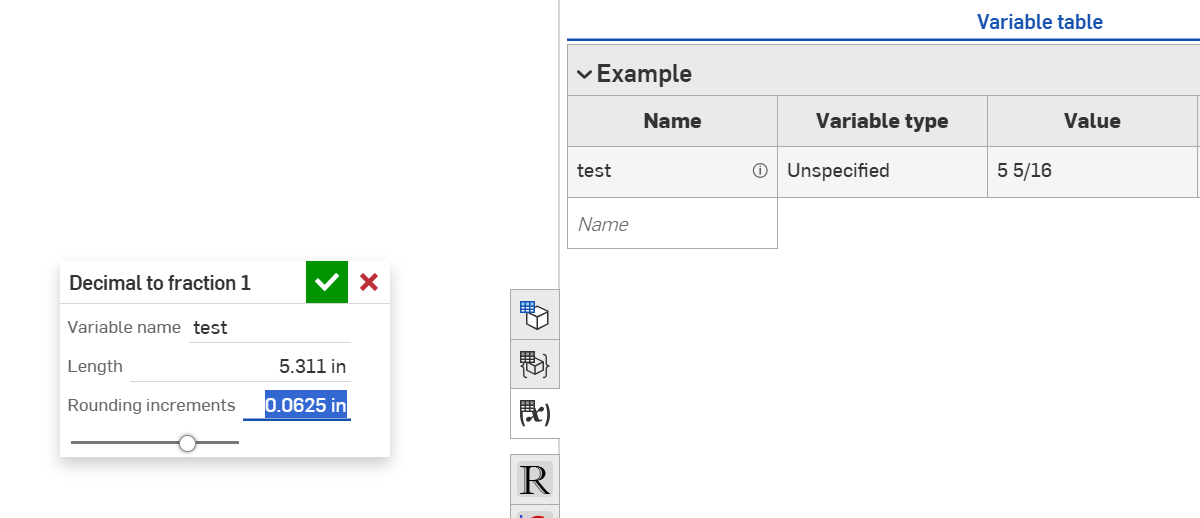
.

Re: Anyone have an FS that can convert a decimal length to a (reduced) fractional equivalent
@jnewth ,
Thanks for the in-depth look and report!
I did add a check for zero numerator and <1 values as I did notice the "1-0/1":
var theString;
        if (whole==0)
        {
         theString=numerator~"/"~denominator;
        }
        else
        {
            if (numerator==0) {theString=whole;}
            else{theString=whole~"-"~numerator~"/"~denominator;}

        }

        setVariable(context, definition.varName, theString);
My use-case realistically is only going use 1/16 or 1/32 range of precision so I haven't tested it away from there. I also expect that the input decimal values should actually match the fractional value so I'm not really trying to "find a fractional equivalent" but rather just format a decimal fraction value as a fraction if that makes sense…
I'll double check the behavior around "edge cases" or switch to the lookup table option as that does seem more "predictable"!

Re: Can robust complex surfaces be modelled.
I'm always searching for new surfacing training and tutorials. @EvanReese, and @GregBrown both have excellent Onshape material on their YouTube channels. @S1mon has stoked breakthrough moments for me. I've also channeled techniques from SolidWorks user Andrew Jackson on his YT channel.
This Onshape video is one of the better ones for surfacing in Onshape.
Of course a solid understanding of what makes good curves and surfaces is paramount. One source that I share with our new hires is the Alias Golden Rules (thanks S1mon!) Although different CAD package it does a great job outlining the fundamentals.
Flattered to hear you might borrow our multi-part studio method. I wish you success!

Re: Can robust complex surfaces be modelled.
@Nick_Holzem. I might borrow this Primary, Intermediate and final practice. Because I've seen designers jump to intermediate and the tool makers go, oh you have to change those edges etc. It in my eyes creates an unnecessary loop and brings a risk of the wrong file going to final. It's funny you mention this, as I was just yesterday talking with one of the designers about getting decisions made on intentionally incomplete designs. Don't polish a design that was bound to be rejected anyway. Better to do 10 stage 1 designs and get direction than it is to to show 3 final ready designs that are all rejected. There seems to be a culture of waterfall project management and perfect deliveries, whereas I guess you are working in a more agile approach at Trek.
Thanks for the feedback on the training. Advance surfacing excellency is something on the to do list. I was watching @EvanReese's video @Matt_Shields posted earlier, surfacing excellency is a deeper topic that had anticipated. I've heard many comments that packaging doesn't need A class surfacing. Which I disagree with.
