Welcome to the Onshape forum! Ask questions and join in the discussions about everything Onshape.
First time visiting? Here are some places to start:- Looking for a certain topic? Check out the categories filter or use Search (upper right).
- Need support? Ask a question to our Community Support category.
- Please submit support tickets for bugs but you can request improvements in the Product Feedback category.
- Be respectful, on topic and if you see a problem, Flag it.
If you would like to contact our Community Manager personally, feel free to send a private message or an email.
New FeatureScript: 3D nesting

Hi everyone,
I wanted to share a new small FeatureScript tool-chain, mainly targeting powder bed fusion AM. It’s specifically focusing on the workflow around build preparation and 3D nesting. Although originally designed with powder bed AM in mind, 3D nesting could be useful in other domains too.
This whole project was started on Saturday, and wrapped up Sunday night. Finally got around to send it today. I used some basic ‘vibe-coding’ with ChatGPT to get the basics of the 3D nesting algorithms implemented. All the supporting tooling, and AI-slop-cleanup is done by me.
This is not intended to produce the most space efficient, high-density nest, and will be wasteful with space in some cases. There are way more capable tools out there. But, all such production tools are hidden behind a fairly high cost, and when I needed this functionality, I couldn’t find a single one that was free. So I set out to make my own free open source version, natively in Onshape FeatureScript. Why do it anywhere else than where the part geometries already are?
In real projects, parts intended for printing are often:
- Spread across multiple Part Studios and documents
- Present as both parts and composite parts (e.g. print-in-place designs)
- Defined once in design, but instanced multiple times in assemblies
- Designed with a preferred print direction in mind, but not aligned to Z
- Prepared for printing outside the CAD system
This tool-chain aims to make build preparation an in-CAD workflow, without requiring heavyweight optimization or external nesting software.
The tools provide a workflow and are designed to be used together, but each is useful on its own. Please don’t hesitate to use any subset for other use cases. I could have pulled most of the separate tools together into a fewer set, but that would have meant the GUI would have been way too cumbersome to use. I opted for this.
- Multi Derive
Often, the parts you want to nest are not designed in the same Part Studio, but are instead scattered across multiple Part Studios and documents.
Unlike many other derive functions, this is a single feature that allows multiple sources of parts to be brought into the same location. It filters for solid and composite parts only, so no other construction geometry is included. It's also bare-bone by design, for instance parts come at their default location, since the nesting don't care where a part is located. Optionally, it filters for parts tagged as “AM.” And, it outputs a query variable for all parts to nest. - Tag for AM
Print-in-place workflows require the design to exist as both parts and composite parts within the same Part Studio, but which one should be printed? The same issue applies to Part Studios that contain additional parts not intended for additive manufacturing.
This feature is used in the source Part Studios to pre-tag parts or composite parts as designated for printing, making the Multi Derive tool significantly easier to use. - Reorient parts
When a part is designed, the DfM printing direction is often considered, but it is rarely designed with the print direction already aligned to the Z axis.
This FeatureScript aligns parts so that the desired print direction is aligned with the Z direction in the Part Studio. - Duplicate in Part Studio
It is often desirable to have more than one instance of most parts, but the Part Studio don't contains these duplicates, the assembly does.
This feature creates duplicates within the Part Studio so that the desired part quantities are met, enabling accurate nesting, build-volume utilization, and additive manufacturing preparation. And, it adds to the query variable for all parts to nest. - Nesting (shelf-based with optional Z-interlocking)
And finally, the nesting tool itself.
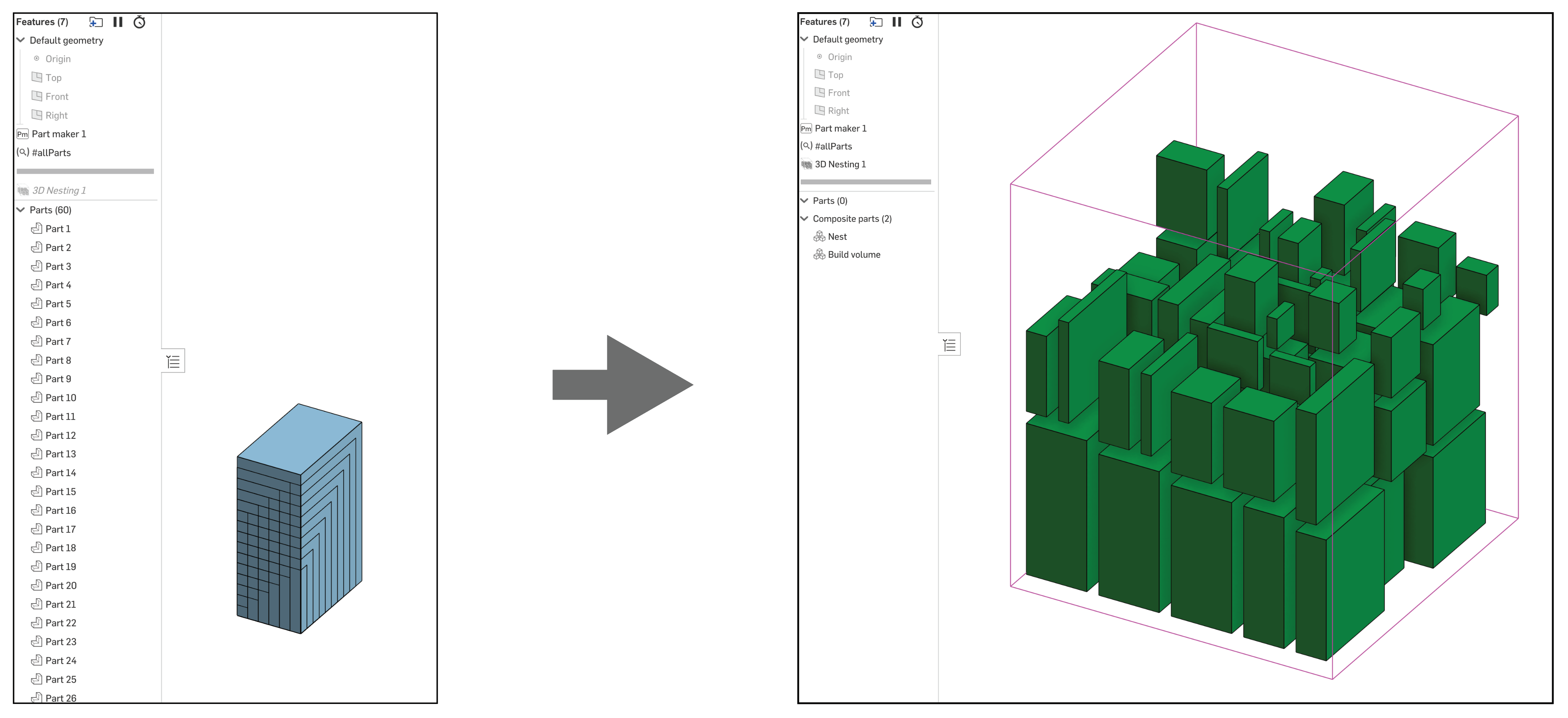
This feature arranges all selected parts and composite parts within a user-defined build volume according to specified nesting parameters, such as spacing, height bucketing, and optional Z interlocking.
Parts that cannot be placed within the volume are explicitly reported, and the resulting arrangement is generated as a single closed composite to support efficient single-file export for downstream operations such as slicing, simulation, and build preparation.
Performance notes
Onshape recommends limiting Part Studios to no more than 10 parts. However, many use cases for this tooling may exceed that recommendation by an order of magnitude or more. Below are my recommendations; please review Onshape’s best practices to ensure acceptable performance and to avoid potential issues.
Increasing the number of parts in a Part Studio can impact regeneration time, graphics performance, and overall model responsiveness. Users are encouraged to minimize source complexity and suppress unnecessary features where possible. Same with reducing tessellation quality to coarse.
It is recommended to use these tools only for downstream workflows, such as nesting, build preparation, or analysis, rather than for active design iteration, in order to limit performance impact. I.e. don’t insert parts from this into assemblies or derive further.
Furthermore, it is recommended to perform nesting using these tools in a standalone document, rather than within the same document where the design is created. This both preserves performance in design-focused documents and encourages the use of more performant version-based derives.
I have had a prior dive into FeatureScript caching, and I do consider if that could be useful for this. Especially the overlapping computations for Z interlocking are the most resource intensive. I might implement caching if I find it too cumbersome in my usage.
Let me know if you find any bugs or such.
Comments
-
Gonna tell the PMs to pack their trucks with this script instead of the post it notes and whiteboard they're usually using.
0 -
This is really cool! I'll have a play with it when I get a moment.
0 -
I'm trying this out - see if it can be helpful with pallet layouts.
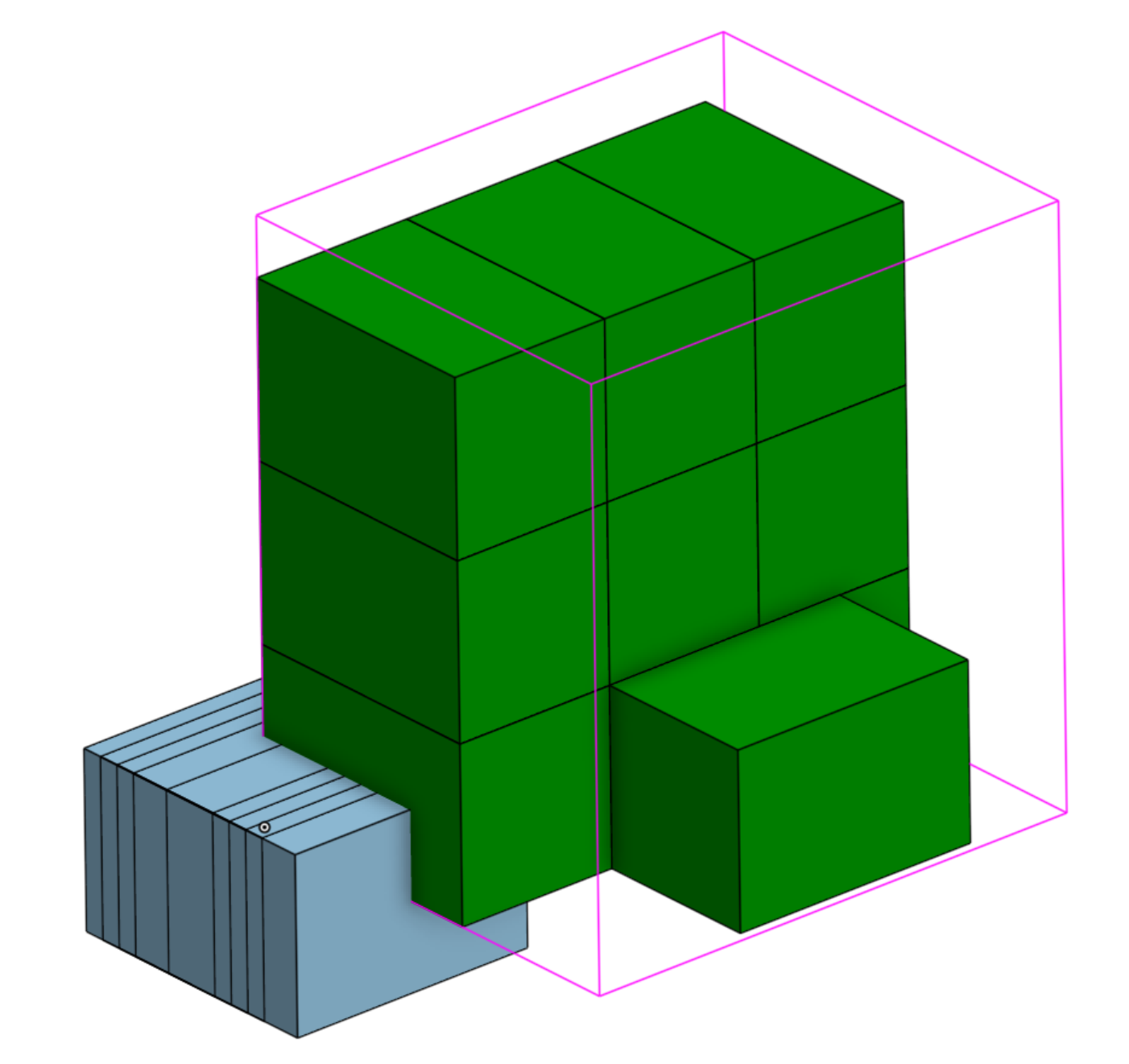
In this example, it will not place all of the parts in the volume. I have created a rotated copy (since I know that my layer needs to be 3 boxes in 1 direction, and 2 boxes in the other direction for a GSM pallet layout) but it will not place them all.
In another example, it won't place 2 of the boxes (simple 4 boxes on a EUR pallet) on the bottom layer, but will place all four boxes on layer 2 and 3:
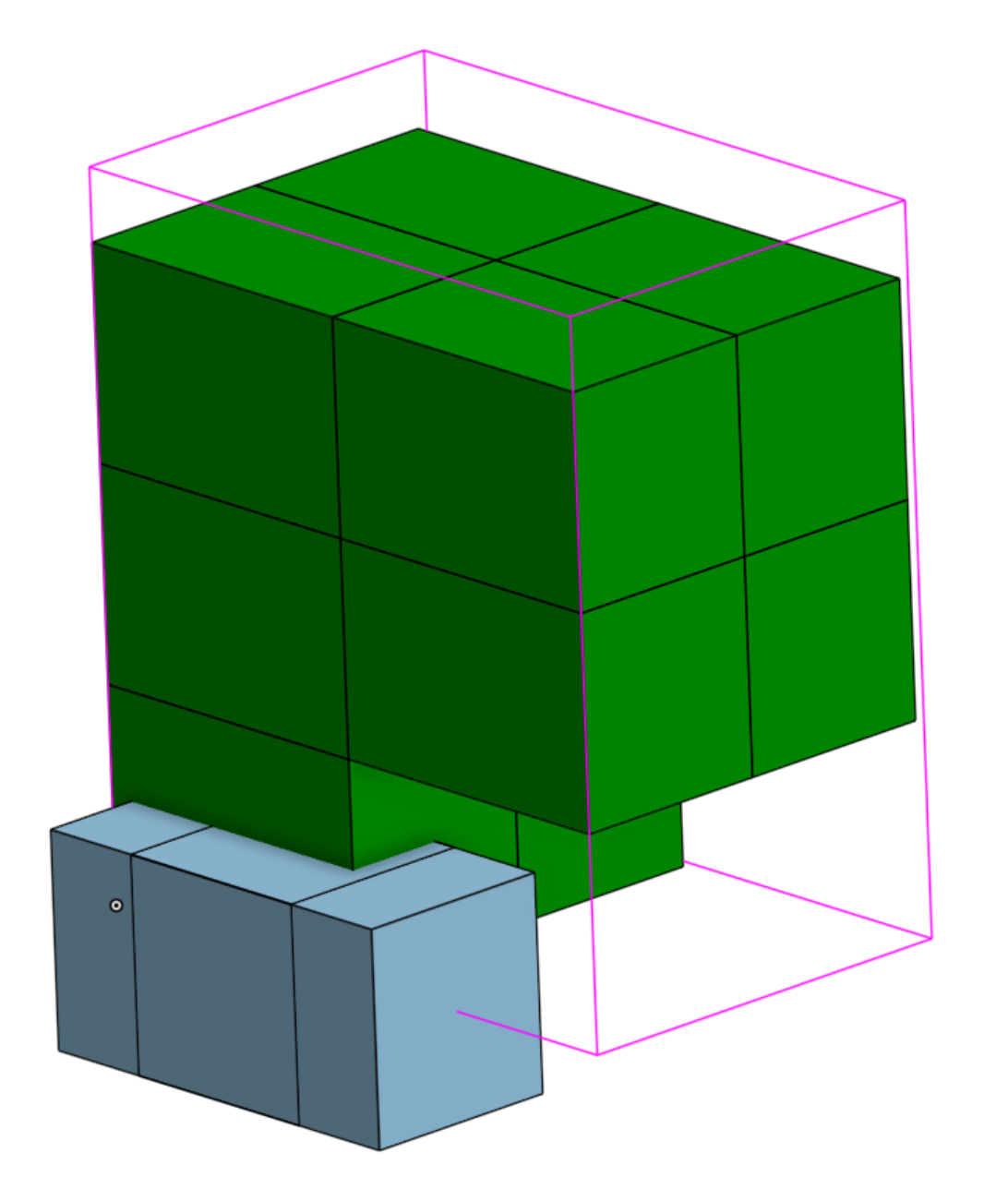
If I make the length of the volume 2 x box length +1mm - it works! All spacing values are set to 0mm.
It does not seem to rotate the parts - which is why I manually created a part rotated 90deg in my first example.
I know this was not developed as a palletizing FS, but it's kind of close! Any known issues you've found that might fix my issues?
Thanks!
Romeo
0 -
Hey! Cool initiative! I'm using the built-in nesting tool for our Formlabs SLS (Fuse) printers daily... For me, the ability to rotate parts freely and the ability to lock them – or give the software some freedom in rotating and placing the parts – is quite important.
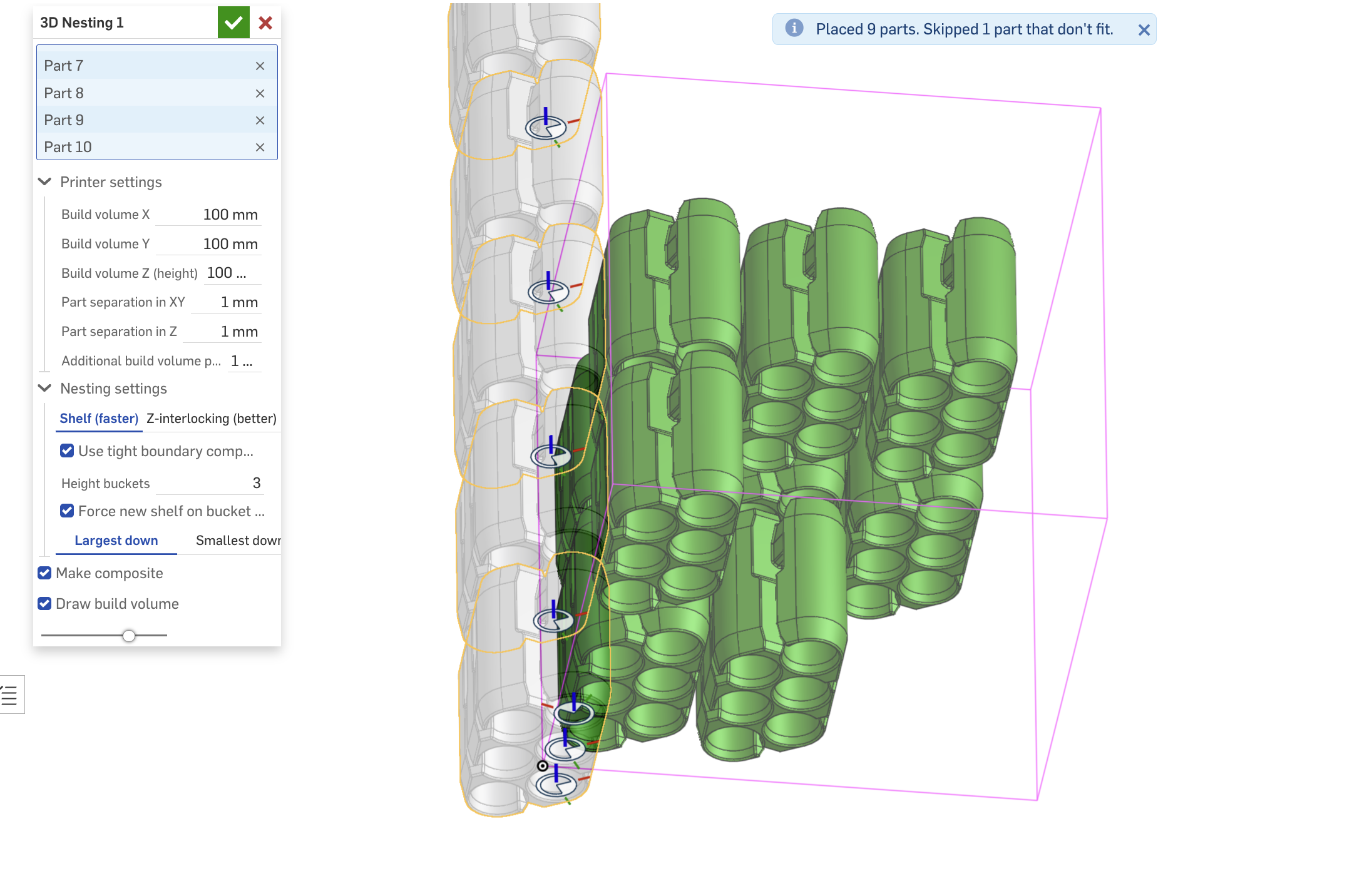
I ran some tests, and it seems the more freeform objects did not get placed. The objects with flat sides did get placed, but even when there was space, some still didn't make it... maybe have a look there :)
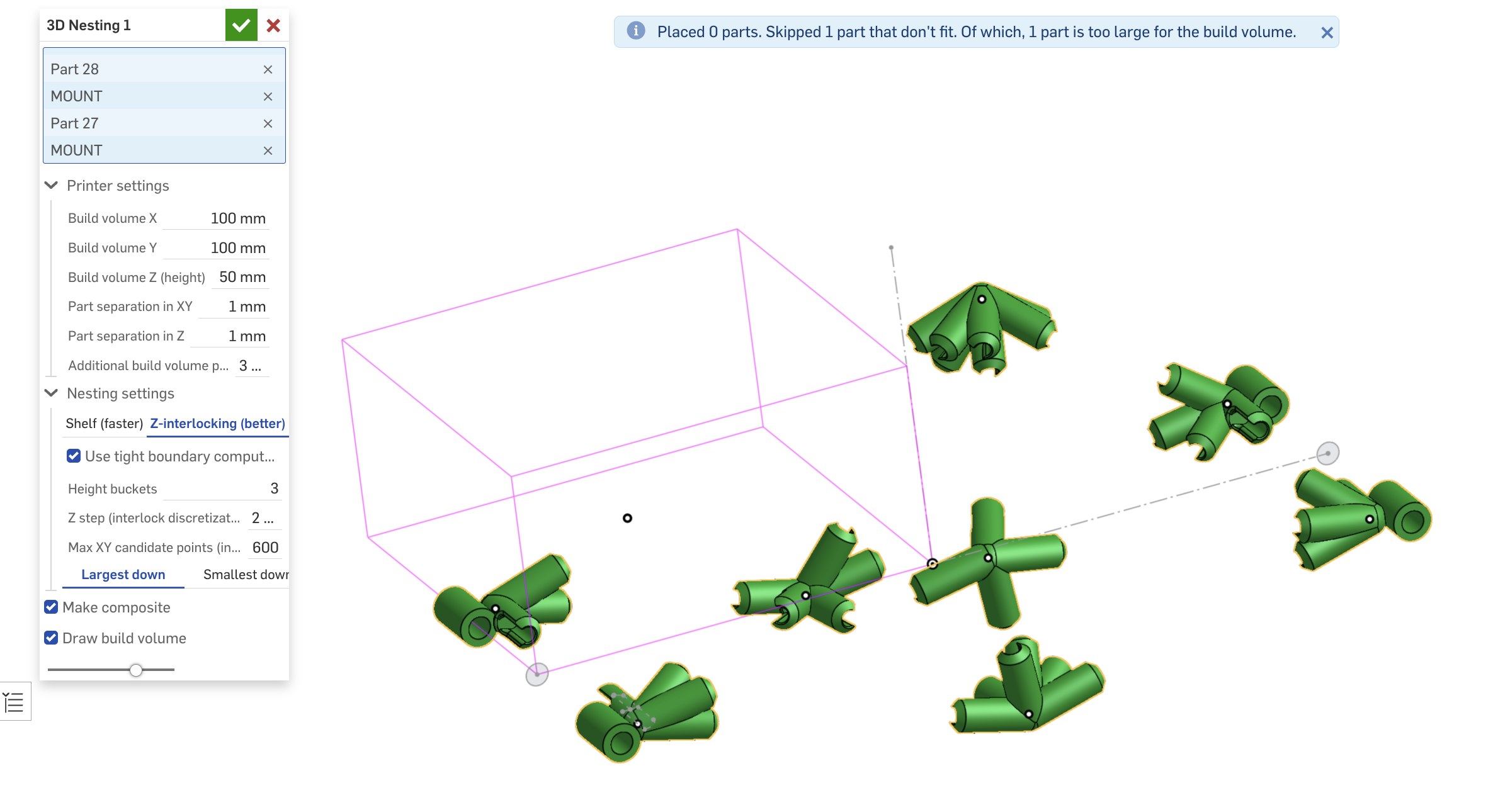
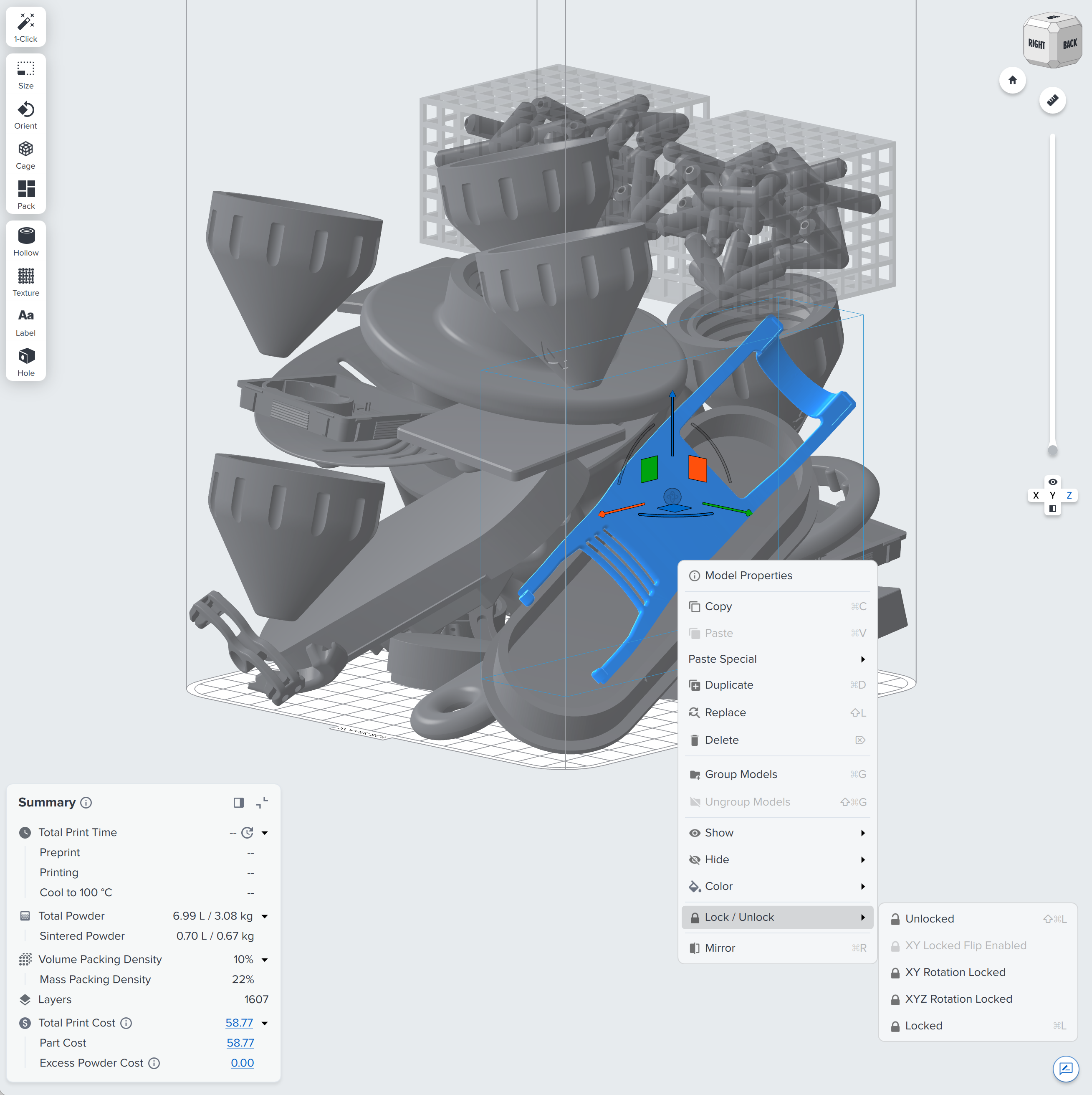
but keep up the good work!
ps: this would be so nice to have in an assembly… maybe one day:)
pps: the Formlabs Preform Software is free - have a look for inpiration, if you like. of course they dont let you export the nested parts:)0