Welcome to the Onshape forum! Ask questions and join in the discussions about everything Onshape.
First time visiting? Here are some places to start:- Looking for a certain topic? Check out the categories filter or use Search (upper right).
- Need support? Ask a question to our Community Support category.
- Please submit support tickets for bugs but you can request improvements in the Product Feedback category.
- Be respectful, on topic and if you see a problem, Flag it.
If you would like to contact our Community Manager personally, feel free to send a private message or an email.
New Features: MC to Transform, Transform to MC

Link to feature
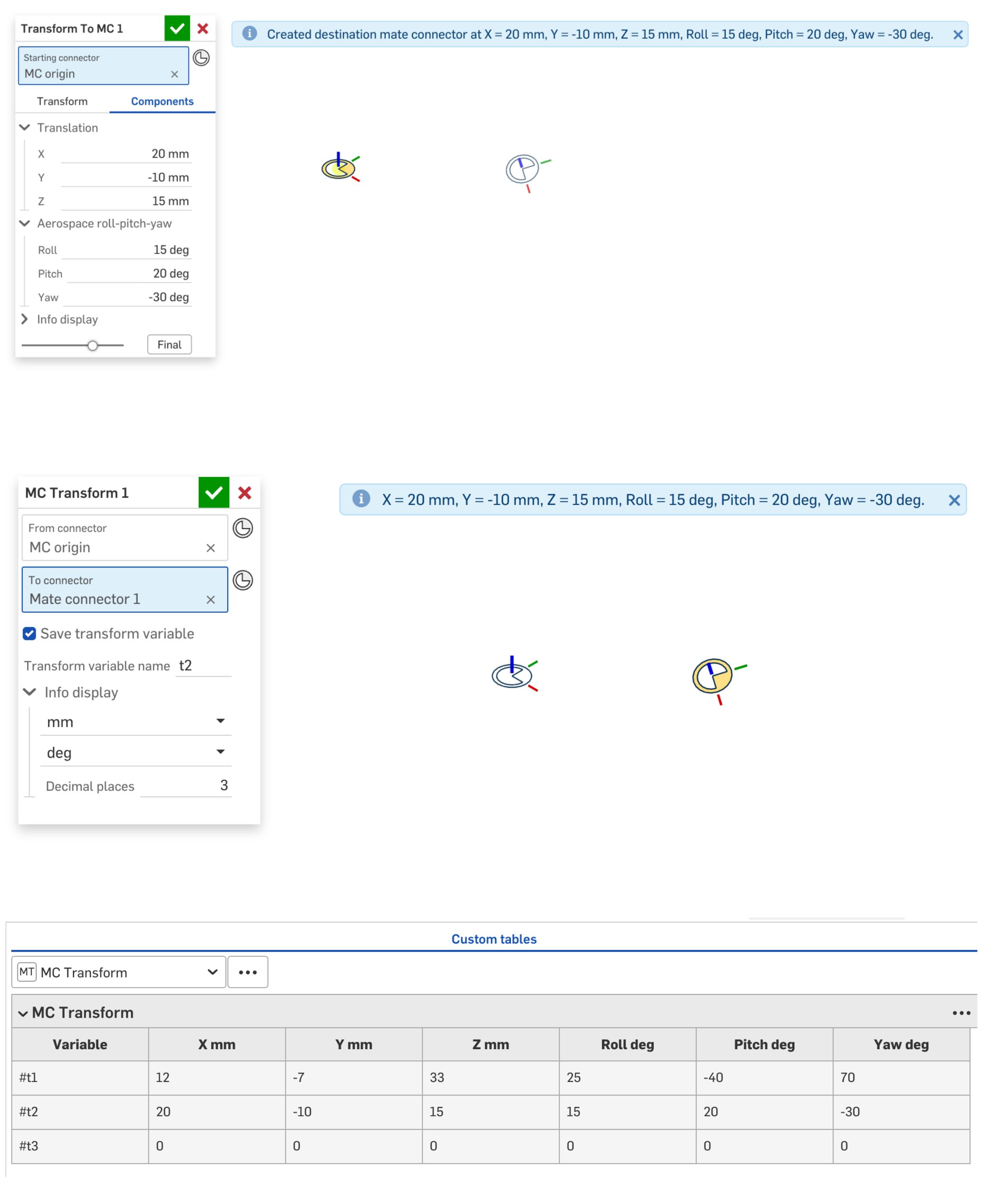
Somewhat similar to some features from @jnewth (see this thread), these two features will measure the transform between two mate connectors (and store a variable and custom table), and the other will generate a new mate connector from an existing one with a transform variable (or entered values).
Unlike the Euler-MC/MC-Euler, these cover the XYZ translations as well as the rotation. For now these features are only working in Roll Pitch Yaw (AKA XYZ).
Simon Gatrall | Product Development, Engineering, Design, Onshape | Ex- IDEO, PCH, Unagi, Carbon | LinkedIn
Comments
-
@slope These look like really useful additions for working with mate connectors and transforms. I especially like that the features handle both XYZ translation and rotation, since that should make more complex positioning tasks much easier. It would be interesting to see how these work in larger assemblies or more complicated workflows.
0 -
I like this a lot, transformation stacks inside a part studio.
Now write a inverse kinematics algorithm to compute the transformation values which allows you to define the end and beginning MC and it connects the dots. You'll probably need to determine the degrees of freedom of your linkages (MC's) before you solve the inverse kinematics. If I remember correctly, the degrees of freedom is fairly simple to compute. You'll have to identify which values are locked down. If all MC values can change, it'd be indeterministic.
The other thing I've always wanted to do is to convert this into matrix notation and then use value with units to solve the solution. I believe value with units will do matrix math. This would simplify solutions to the problems you are creating by doing this.
0