Welcome to the Onshape forum! Ask questions and join in the discussions about everything Onshape.
First time visiting? Here are some places to start:- Looking for a certain topic? Check out the categories filter or use Search (upper right).
- Need support? Ask a question to our Community Support category.
- Please submit support tickets for bugs but you can request improvements in the Product Feedback category.
- Be respectful, on topic and if you see a problem, Flag it.
If you would like to contact our Community Manager personally, feel free to send a private message or an email.
Bearing ball to cage mate

brian_pinder662
Member Posts: 119 ✭✭
Having now managed to create my bearing which is working fine, I am trying to mate the balls to the bearing cage. Could anyone say which mates would be best use as i have tried several without success.
Regards Brian.
Regards Brian.
0
Best Answer
-
Owen , cracked it used group mate between ball and cage which appears to have worked quite well. Balls and cage rotate as required when inner ring is rotated. Thank you for your assistance.
Enjoy rest of your day Brian.0
Answers
-
Hi Brian. That was in John's example that I linked you to.Have fun,Owen S.
Business Systems and Configuration Controller
HWM-Water Ltd0 -
Owen, I have got as far as the example you referred me to, but my bearing has a cage connecting all the balls together. I have constructed the cage using a solid works you tube example which has worked out fine. It is connecting the balls to the cage that is the problem so that the cage stays with balls when rotated. In the solid works example a straight mate seems to do the job however I know in Onshape this will be different.0
-
Howdy.I'd imagine a group mate will do here. If not if you post a link to your file I'm sure someone will dive in and help.Cheers,Owen S.Business Systems and Configuration Controller
HWM-Water Ltd0 -
Owen , cracked it used group mate between ball and cage which appears to have worked quite well. Balls and cage rotate as required when inner ring is rotated. Thank you for your assistance.
Enjoy rest of your day Brian.0 -
Great news, glad you're sorted
 Cheers,Owen S.Business Systems and Configuration Controller
HWM-Water Ltd0 -
An alternative to a group mate could be to create a sketch with points and a circular array to place the balls precisely where you need them to be. You can also use some in-context relations to ensure there is some associativity between the sketch and the bearing races. Just insert the sketch into the assembly and mate it with one of the races to lock it then mate each ball to a point in the sketch.0
-
well, if you are gonna group mate, than may as well make the whole bearing a solid.

The only reason to do into this level of detail is for CAD practice, or marketing animation.
Otherwise you are slowing down your model for no reason. A bearing in CAD shouldn't me more than a single revolved cylinder with at most an indentation to represent a bearing seal or ball profile. which helps identify race thicknesses.
a true bearing motion will have the balls moving half as fast as the inner race.
Which is where the gear relation comes in handy.
I don't know, to me if you don't do it to completion, than why waste the effort going half way when it will only slow down the system.
Sorry @michael_mcclain I wouldn't recommend in-context for something as simple as a bearing. That is perfect territory for part studio1 -
Looks like i am late to the party - here is mine

https://cad.onshape.com/documents/89d6e292d210f1ed8ab1413a/w/2402b88629436f3b8e5d98d2/e/6de2d435379583163c3e1bf8
Please note the use of layout sketches and only 1 part per part studio!!!
A cage would be done as an in-context Part Studio.
Have fun Philip Thomas - Onshape2 -
0
-
@john_mcclary - it's good practice all round, hmm - you're right, there is a performance benefit to doing it like that. It's in! Philip Thomas - Onshape1
-
Yea, as soon as i started deriving from a "template" part studio into multiple studios, the performance increased by an order of magnitude.philip_thomas said:@john_mcclary - it's good practice all round, hmm - you're right, there is a performance benefit to doing it like that. It's in!
and it is still a single point edit that flows through the whole document. Without all that pesky in-context.1 -
Here's a short video showing how that helped performance.. I screwed up a little while looking for an older model I opened it and it had a chance to render. But even with that initial loading edge, it was still slower.
and as you can see the 338 feature part studio would be slow for any edit.
where as the 18 feature and 11 feature studios is instant.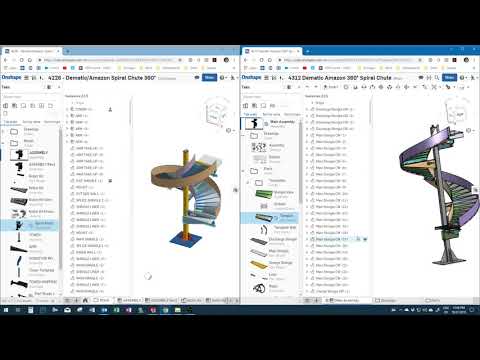 https://www.youtube.com/watch?v=73cNcuT1xs0
2
https://www.youtube.com/watch?v=73cNcuT1xs0
2 -
@john_mcclary, great video but not sure I'll ever forgive you for the, and I use the term loosely, "music"!
Business Systems and Configuration Controller
HWM-Water Ltd0 -
Not a gamer I see... deal with it

0 -
@john_mcclary - yes, you effectively reduced the number of features that need to be regenerated for any given edit - nice!
The bearing now has an 'in context' cage
Philip Thomas - Onshape0 -
@philip_thomas
I like your "company" imprint on it ("Philip's Bearing company")1