Welcome to the Onshape forum! Ask questions and join in the discussions about everything Onshape.
First time visiting? Here are some places to start:
- Looking for a certain topic? Check out the categories filter or use Search (upper right).
- Need support? Ask a question to our Community Support category.
- Please submit support tickets for bugs but you can request improvements in the Product Feedback category.
- Be respectful, on topic and if you see a problem, Flag it.
If you would like to contact our Community Manager personally, feel free to send a private message or an email.
Improvements to Onshape - February 20, 2026
Comments
-
This CF is mentioned in another video by Greg: https://www.youtube.com/watch?v=3oXT2ep5aPY
Thanks again, Greg, for this great, informative "Brownie".1 -
The exceptional ones. And by that I mean the ones working in industries which are the exception, and not the rule. MBD and inspection tables are invaluable to mechanical engineers in most industries where companies have quality management teams and departments that check for consistency within a batch of production or across batches of production. I happen to be in an industry that runs high mix low volume production where I've been responsible for hundreds of thousands of unique parts which all fit within some global tolerance expectations per process but we can't really justify the time taken to label or check datums for any one part unless catastrophic things are afoot on the floor and we need to find where our thousandths went.
I won't personally get a lot of mileage out of MBD in application for my needs but what it IS going to provide is one less barrier for adoption for other companies in industries that surround the weird one I work in where the extra adoption is going to be hugely valuable to me.
1 -
@Derek_Van_Allen_BD Thanks for sharing your environment, reminds me of the small mom and pop shop I once worked in. We relied mostly on general title block tolerances and rarely placed a datum. My last 2 roles, and current, are of products of high precision, and now high production where cost can be effected by proper/improper tolerance and inspection.
I also agree with @kenn_sebesta167 , Onshape has become much more elaborate than a handful of years ago. I'm grateful to have started back then and have been able to grow with each new release. I find it hard to keep up with all of the enhancements each week primarily in areas I don't use day-to-day; CAM/Render Studio, etc. Developers have a lot to consider with Onshape tiers and offerings.
1 -
The vibe is very much mom and pop shop, if mom and pop stumbled into a market where they needed to scale up 10x from where they started and adopt practices that scale the original business model, but "industry standard" practices were never designed to handle the deliverables we produce. So a substantial portion of the job requires being ahead of the rest of the world for some of your practices if you want to get any bigger.
Or at least that's how I approach it.
0 -
@GregBrown great video! Can I change between max material, nominal & least material and will the geometry update?
This will change how we design and manufacture. As a motorcycle enthusiast, with new design approaches like this , maybe KTM wouldn't have soft cams, Triumph 400's wearing out in 500 miles and Kawasaki over torquing countershaft journal bearings. I've never seen so many "do not ride" notifications before.
1 -
This is what I've been wondering is whether we can now do assembly analysis by running parts through their ranges and simulate how builds might break if things are at the maximum extents of their specified tolerances.
1 -
MBD isn't working as shown in the demos for me. There is no tolerance icon to click on or expand.
Followed the example from Onshape on YouTube step by step. What's wrong?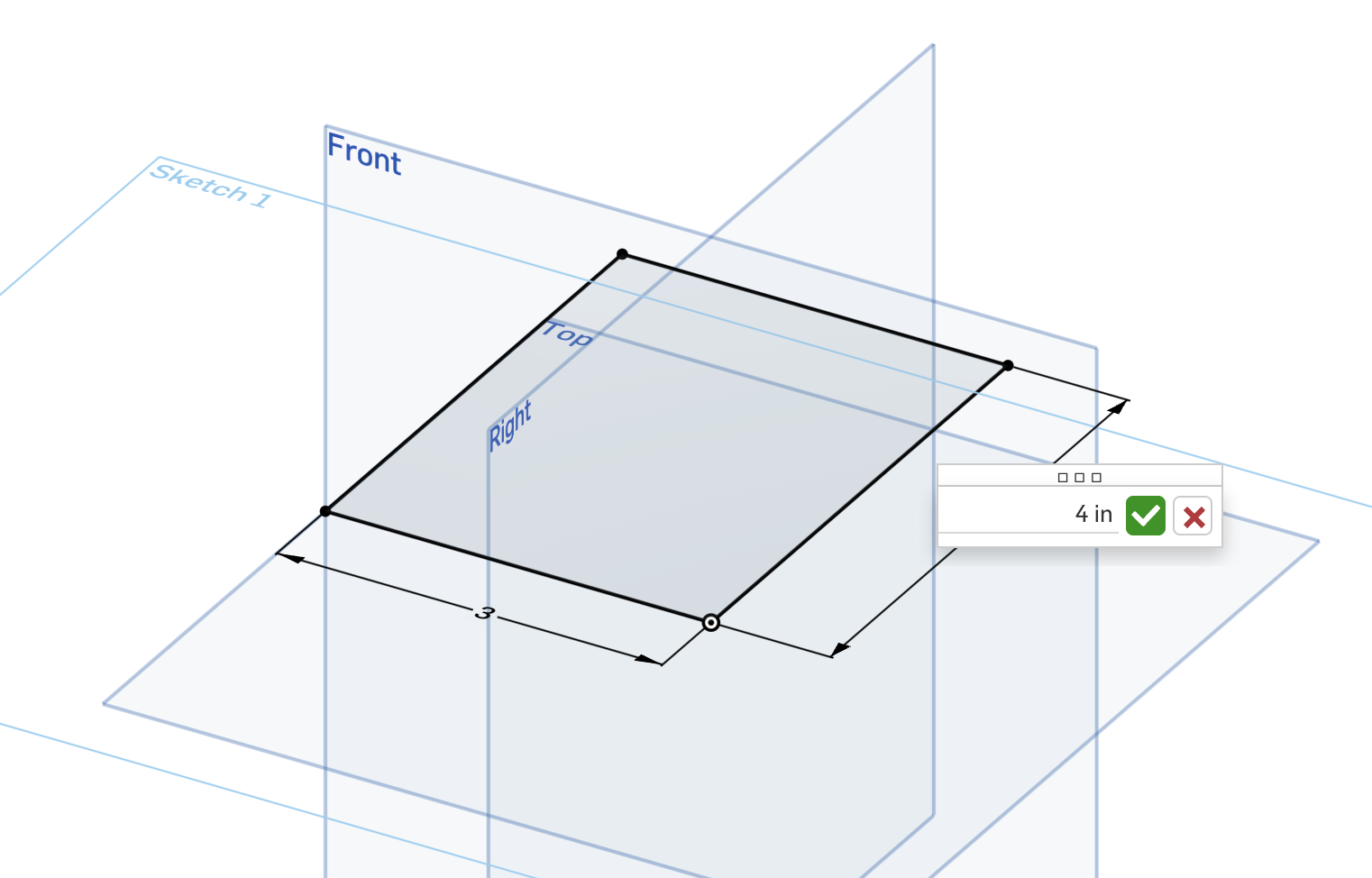 0
0 -
Was also confused by that for a bit…
The dimension has be from line to line rather than just the length of the side of the rectangle.3 -
That was it! Thank you.
It works for a new part, but old parts can't be used. No way am I going to redimension everything now.Also still can't get it to create a Datum.
0 -
@AuroraRon see my answer here:
1 -
Most! Based on what I see, few engineers in the US get involved in manufacturing. Our engineers go into all kinds of domains which don't involve manufacture, such as robotics, mechatronics, firmware, testing, FAE, operations research, material science, etc… I don't have an exact number, but it's definitely the minority I see get hired into a job which has them working with component manufacture.
We teach all our engineers— no matter the discipline— the concept of tolerances, but only our MEs are going to go deeper and learn how to use them for manufacture. GD&T is a sophisticated language and like all highly technical domains most people are outsiders and thus don't need it. As such, OnShape's GD&T will certainly seem like visual noise to many engineers, including a large number of MEs. That's probably okay, since they're not the ones who will pay to keep the servers running.
0 -
Some people will not be design engineers but instead be analysts of different sorts or end up being project managers. I still think they need to know a bit about tolerances and manufacturing but they do not need to know how to use the software tools to apply them on a drawing.
That said, I don't think having a lot of features is a problem and I do not think Onshape should start hiding stuff just to make a "cleaner" user interface. There's plenty of things in every software package that are irrelevant to me, so I just ignore it. I have no idea how to use the render studio, CAM studio or PCB studio, because it is simply irrelevant to me and I have also not looked twice at the revision management in Onshape or a lot of other things, because we simply do not use it and have our own system instead.
I'm happy that Onshape is becoming more sophisticated and powerful with each update.3 -
The biggest barrier to MBD's success historically has been adoption so putting it out in the middle of the interface was a smart choice to get people familiar with it. The presence up front will have curious people poking at it and playing around with it which will make it more likely to end up in people's practices.
^This is essentially how I learn everything.
5 -
@PeteYodis how will you handle drafted sidewalls with MBD? In plastic part design (or any other manufacturing method that requires drafted faces) there are many inspectable faces that are not parallel faces (Features of Size?). These can be measured by metrologists (calipers, optical comparators, CMM) by measuring the largest point (often at the parting line of the tooling parts).
Currently for a drafted extrusion, MBD works on the sketch, works on the "begotten" extruded faces, but then disappears if draft is added.
In this case, the ability to add MBD to edges will be very useful!
I LOVE the fact that MBD allows us to think about tolerances earlier in the process.
5 -
@romeograham Yes, right now we are suited to parts without draft. Parts with draft will need another set of abilities.
2 -
Had a quick play with the MBD. Very cool. So now we can have isometric dimensions on models but not drawings!
On small thing. I noticed that when selecting a cylinder or hole the option for holes and fits tolerences is available, but not on rectangular objects , where it is less common, but sometimes useful for things sliding in slots.
Engineering textbook: https://hwh.stephenteacher.com/txtbook.html1 -
Absolutely a must! I know you guys are working on it, but I want it now!

Ramon Yip | glassboard.com
0 -
MBD represents a real shift in workflow. With properly defined model-based data, traditional drawings become optional in many cases. Modern CNC and sheet-metal systems are increasingly capable of consuming models with embedded MBD directly, reducing documentation overhead and minimizing interpretation errors.
1 -
@Derek_Van_Allen_BD we'll have new project architectures to handle MDB, for sure. Since dimensions are inside part studios, then most work will be done inside part studios. I've already committed to using parts studios for design layouts. On larger projects, tying all these layouts together using assemblies could be architected using incontext and a master part studio. Master modeling is already a design approach pushed by the SW & OS community and could be the vehicle you're talking about. For me, on large projects, project level datums, references are minimized and easily trackable. If everyone is going to use them, they have to easily discoverable.
If you come up with any ideas, please post'm.
0 -
@billy2 oh I'm the master modeling zealot at my company, although my preferred flavor of it is space claim solids and a pure Derive workflow with as little in-context referencing as possible until late in the project. I know @christopher_dziuba uses a similar workflow in their work as what I've adopted at Boss Display and it's for sure the way to go for large builds.
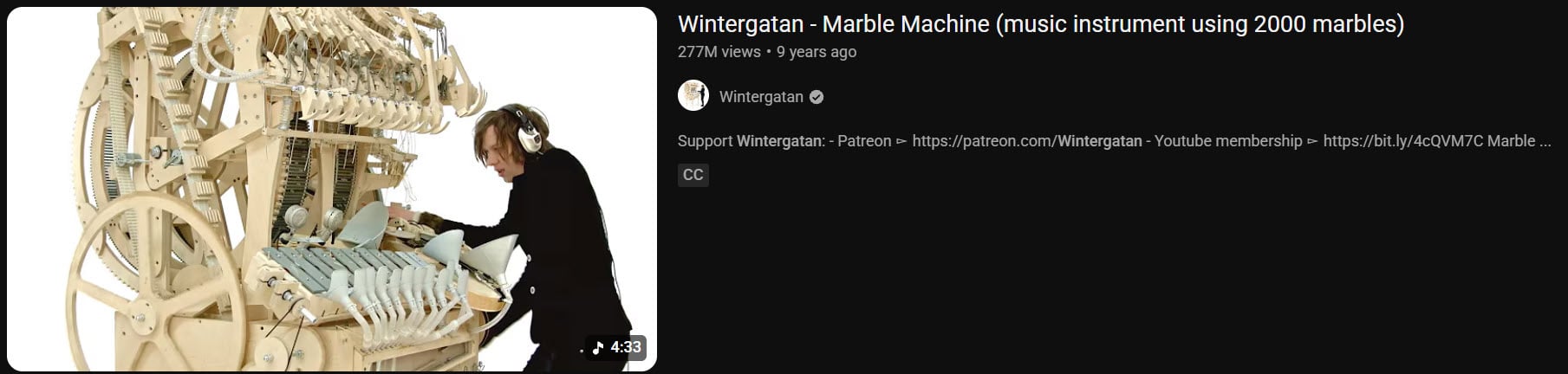
We'll see how much of it comes out in the edit but I just did a workflow exploration of the master solids method with Martin from Wintergatan that will be going up on his channel at some point later this week.
My prior comment about assembly analysis was more for exploring the range of mobility for dynamic assemblies of parts that are within their specified tolerances and seeing whether the parts still move throughout their whole intended paths of motion or if your tolerances allow for binding in the assembly when you get parts that are technically within your specs so you have the heads up to redesign things before they make it to production.
2 -
.."Derive workflow with as little in-context referencing.." Same!
Could you link Martin from Wintergatan's channel? My first search brings up this guy 😅
 1
1 -
That's the guy, he's starting a new build in Onshape
4 -
Awesome, I watch him all the time. He's got some cool machines. I always love seeing youtuber's pull up Onshape in their videos. 😊
2 -
Just curious - for MBD callout alignment - coincident, parallel, text orientation -
Why didn't you make a mate connector as an option? It seems so perfectly suited to that use.
1 -
Some of my friends refer to Onshape as "YouTuber CAD" with a negative note but I spend way more of my time than I should on the maker side of YouTube over the years and the number of plugs I'm seeing for Fusion or Solidworks for Makers from content creators is dropping month by month and it's not because Onshape's marketing team is cold calling people and trying to get featured, it's mostly word of mouth referral from other people who need software that just works.
8 -
@Derek_Van_Allen_BD Please let me know your results when switching between derived to an assembly. As you know, motion & BOM's are the main drivers for this decision. Sometimes I struggle with both structures overlapping data to get what I want. I'm not saying what I do is good and needs more thought.
I am finding that my part studios are getting huge but I do refrain from instancing stuff, my part studios look funky. I always start a design with a part studio and assembly just like the default document shows us. The dance to maintain both is common to me but I worry about someone looking at my structure and saying "what is this, was this guy insane?".
As far as performing a tolerance stack analysis, I'll focus on the part studio. I'm still not sure how to define MDB max/min so it'll show the results I'm trying to achieve and then toggle between for a stackup analysis. I feel this won't be automatic or may not work in its current state.
It's exciting to be able to get all these design requirements shoved into the design tool where it should be.
0 -
@billy2 I do make exceptions for subassemblies that need mobility but those will usually be made with composite parts of static stuff from one or more part studios glued together in as minimal context as needed to get the motion defined while the rest of my master assemblies is static anchored part studios inserted as rigid and all mated to the origin. As for the assembly BOM? I don't use it. At all. That probably sounds like CAD heresy but when your BOM lists as 10000 components that are all truly and genuinely unique parts it does not make any sense to try to wrap your head around the 400 items in that list that have quantities of more than 1. So we do our part tracking with part names and other metadata that exports to our vendors while entirely ignoring the BOM and release management system.
0 -
It would also be great if you could make not just MBD but normal sketch dimensions and other features like fillets and chamfers show up automatically in drawings like you can in Creo. I am a former Creo user and this is one of the features I miss in Onshape, it speeded up the tedious work with drawings. Onshape is not yet as advanced as Creo, but I hope PTC will not stop developing/keep it simpler to avoid canibalizing on more expensive Creo licenses.
https://www.youtube.com/watch?v=VSpv2KQrwvY
https://support.ptc.com/help/creo/creo_pma/r12/usascii/index.html#page/detail/dims_about_showing.html#wwID0EHIHU1 -
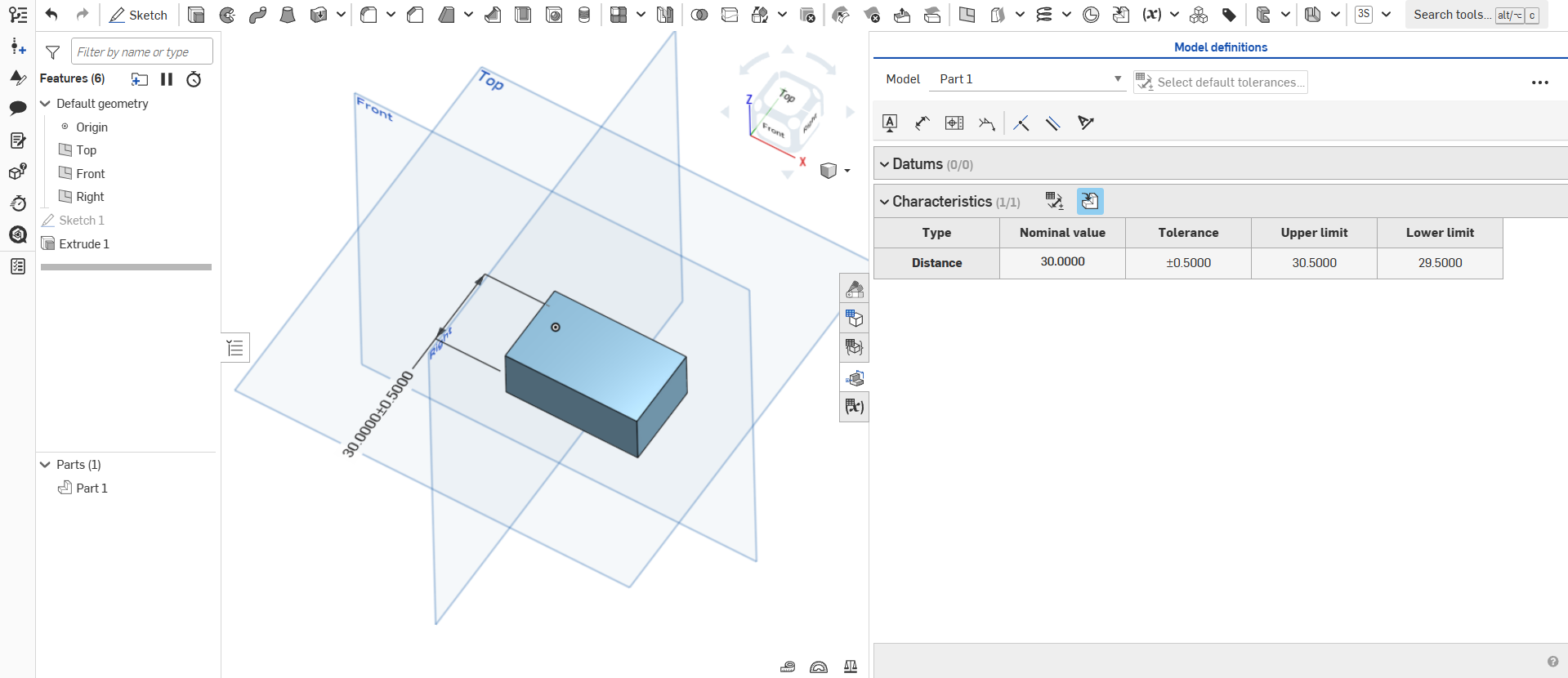
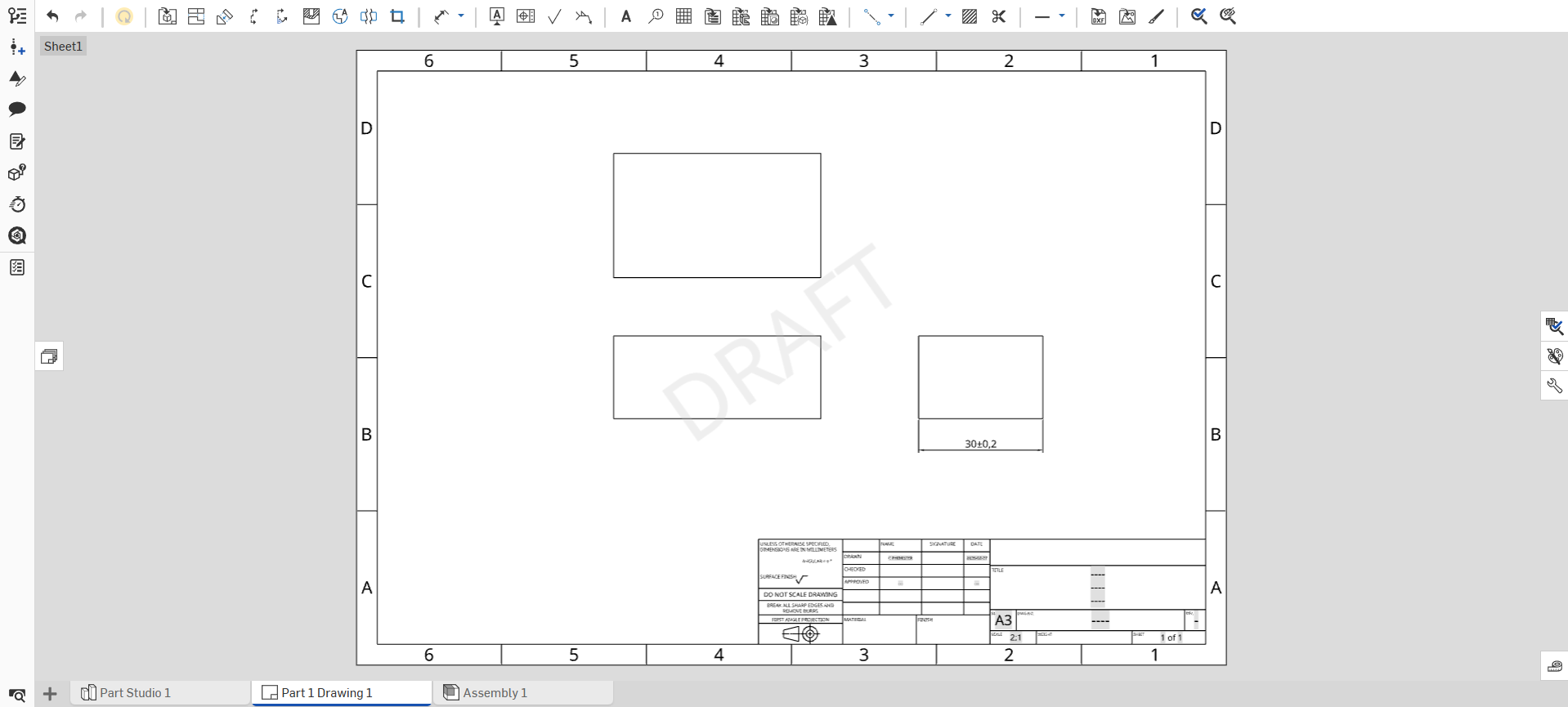
It's great to see Onshape adding MBD functionality and hopefully this will allow Tolerance Analysis functions to be added in the not too distant future. However, before that, I would hope that we would see an update that allows us to show dimensions and geometric tolerances that have been added to the 3D part, within the drawing. As it stands, the concept of "a single source of truth" falls down, when you can create a part and associated drawing with different tolerances applied to the same dimension.
 5
5 -
I had a thought and decided to go and check and it turns out that you can in fact use variables in MBD dialogues, so you could automatically relate a clearance dimension (eg added with a "move face") and the MBD tolerances.
For example make the clearance between two parts 2X the tolerance value.
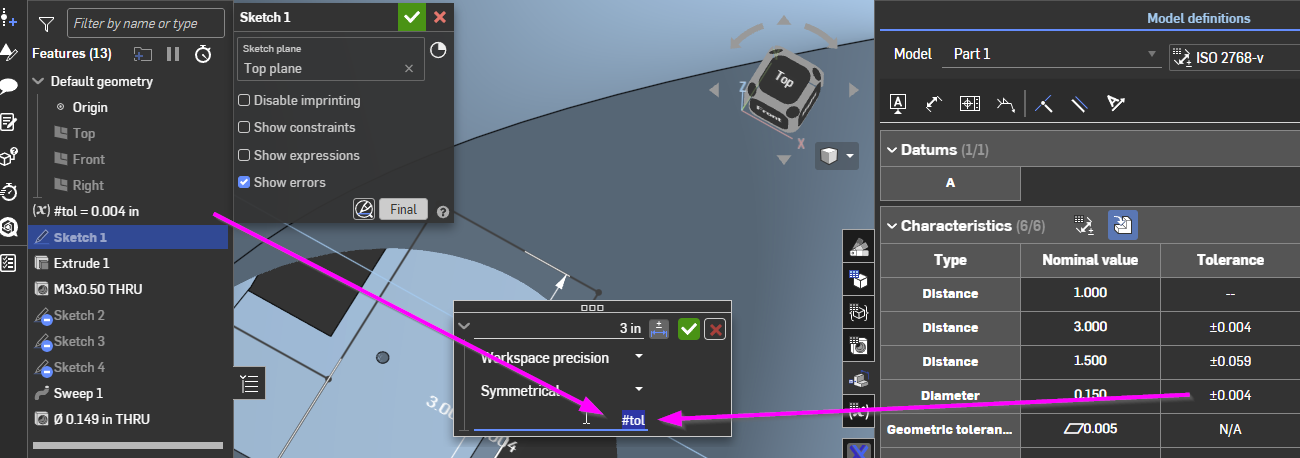
As far as getting the MBD info into drawings, the hole feature basically previews how that would work as the part studio tolerances have been brought into the 2D drawing environment for a while for these.
3